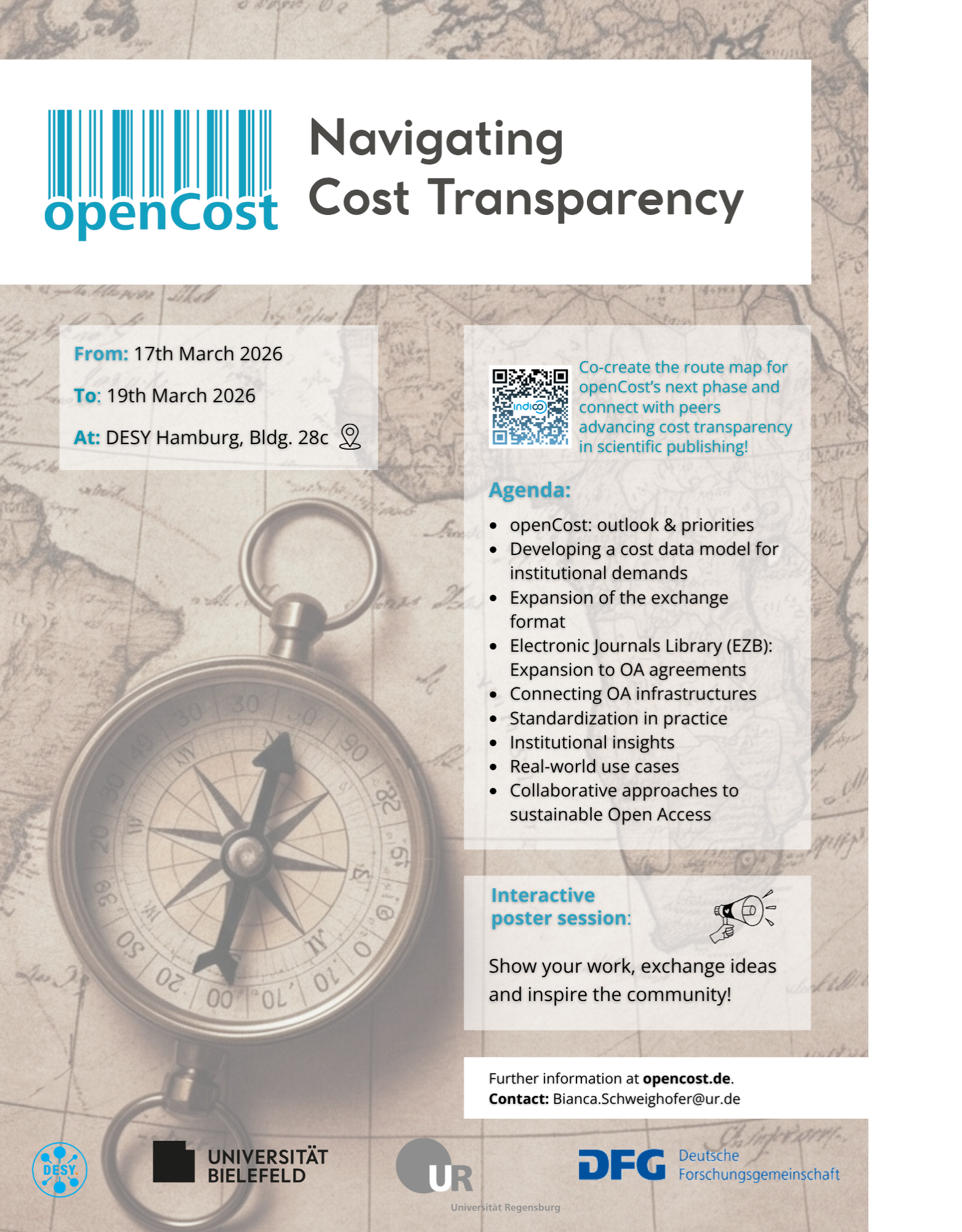
openCost: Navigating Cost Transparency

Europe/Berlin
DESY Hamburg, Bldg. 28c
Alexander Wagner (DESY Hamburg), Bianca Schweighofer (University of Regensburg), Christoph Broschinski (Bielefeld University), Colin Sippl (University of Regensburg), Cornelia Lang (University of Regensburg), Dirk Pieper (Bielefeld University), Gernot Deinzer (University of Regensburg), Julia Bartlewski (Bielefeld University), Lisa-Marie Stein (DESY Hamburg), Silke Weisheit (University of Regensburg)
Description

From Tuesday, March 17 to Thursday, March 19, 2026, the openCost conference "openCost: Navigating Cost Transparency" will take place at the DESY in Hamburg.

openCost: Navigating Cost Transparency

When? 17th - 19th March 2026

Where? DESY Hamburg

Program: The conference will focus on insights into the second phase of the openCost project and joint discussions on ways to achieve cost transparency in scientific publishing.

Initial results on the development of an internal metadata schema for cost recording, the expansion of the exchange format, and application scenarios in the Electronic Journals Library (EZB) and repositories will be presented and discussed. Questions of technical implementation, data integration, and process design will also be addressed, with a particular focus on the further development of the openCost standard, institutional use cases, and the networking of open science infrastructures to promote cost transparency.

The aim is to jointly set the agenda for the second phase of the project, to bring together practical perspectives from the community, and to create space for networking and exchange.

Further information about the conference, the program, and registration will follow shortly.

We look forward to your contributions and to sharing ideas with you in Hamburg!


The openCost project:

The DFG funded project „openCost" creates a technical infrastructure to comprehensively record publication cost data, make them openly distributable by means of standardized interfaces, and accessible by well known platforms like EZB, OpenAPC or the the OpenAccess Monitor.

Registration
Registration
Participants
    • 1
      Welcome and Opening of the Conference
    • Keynote: Why does the DFG support the development of information budgets and standardized cost data?
      • 2
        Why does the DFG support the development of information budgets and standardized cost data?

        The presentation will address the various ways in which the German Research Foundation (DFG) is working toward the standardization of cost and other publication metadata in the scientific publishing sector.
        It will embed this support in the strategic discussion on open access and address the framework conditions and objectives of information budgets. It also explains the funding strategy approach that underlies standardization. In doing so, it also addresses questions about the obstacles and difficulties involved in standardization.

        Biography:
        Dr. Angela Holzer is responsible for funding in the area of digital publishing/open access at the German Research Foundation.

        Speaker: Angela Holzer (German Research Foundation)
    • openCost: Navigating Cost Transparency
      • 3
        The second phase of openCost: Navigating Cost Transparency
        Speakers: Alexander Wagner (L (L Bibliothek)), Dirk Pieper (Universität Bielefeld), Gernot Deinzer (University of Regensburg)
    • 15:30
      Coffeebreak
    • Diamond Open Access
      • 4
        Collective Funding for Diamond Open Access: Insights from the Open Library of Humanities

        The Open Library of Humanities (OLH) is an award-winning, scholar-led publisher of humanities research based at Birkbeck, University of London. OLH plays a leading role in journal flipping, supporting the transition of titles away from commercial publishers and returning ownership to scholarly communities. Over the past two years alone, OLH has welcomed 14 journals, including several high-profile transitions from major commercial presses.

        OLH’s diamond open access model is funded by over 300 member libraries through a collective funding model. Through tiered library memberships, OLH is able to sustain its publishing operations, continue to flip subscription journals, and develop Janeway, its in-house, open-source publishing platform. Since its launch, OLH has grown from 99 supporting institutions and 7 journals in 2015 to more than 340 supporting institutions and 34 journals in 2025.

        Drawing on data from OLH’s latest annual report, this presentation focuses on costs and cost transparency within OLH’s diamond open access model, detailing how much participating universities contribute, how these funds are allocated across publishing activities, and how financial sustainability is achieved.

        Biography:
        Paula Clemente Vega is Community Outreach Manager at the Open Library of Humanities (OLH), where she leads the library membership programme and works on outreach and advocacy to support diamond open access publishing. She plays a key role in strengthening relationships with libraries and increasing the visibility of OLH. Paula holds a PhD in arts and humanities from Birkbeck, University of London.

        Speaker: Paula Clemente Vega (Open Library of Humanities)
    • Open Science Infrastructures
      • 5
        Enhancing Open Science: SCOAP3's New Evaluation Mechanism for Publishers

        For over a decade, the Sponsoring Consortium for Open Access Publishing in Particle Physics–a unique collaboration involving over three thousand libraries, key funding agencies, research centers and intergovernmental organizations across in 47 countries–has successfully transitioned key journals in High-Energy Physics to Open Access, while removing financial barriers for both readers and authors.

        For the 2025-2027 contractual period (Phase 4), SCOAP3 has introduced an innovative mechanism designed to enhance Open Science practices. This new system features an annual assessment of critical Open Science elements, such as the implementation of persistent identifiers (e.g., ORCID, ROR), metadata completeness, the availability of open peer review, compliance with accessibility standards, and alignment with community-driven community values. In this unprecedented mechanism, publishers’ financial compensation is adjusted based on their performance in these areas, incentivizing continuous improvement in their open access offerings.

        This presentation will provide an overview of this novel evaluation and incentive system, highlighting how SCOAP3 is promoting a more transparent and sustainable open access publishing ecosystem, where costs are more closely tied to the services provided by the publishers to the community. It will also present the results of the first evaluations in 2025 and 2026, offering insights into publisher practices and the broader implications of this approach for the Open Science community.

        Speaker: Anne Gentil-Beccot (CERN)
    • openCost: OpenAPC expanded: Contracts in Focus
      • 6
        OpenAPC expanded: Contracts in Focus

        Since 2014, OpenAPC has been collecting and publishing cost data on open access publishing from research institutions and consortia. Until now, the infrastructure has been purely publication-centered: contract information was previously only visible indirectly, through associated articles. Given the growing variety of publishing agreements – including transformative agreements, memberships, and agreements with fully open-access publishers – it has become evident that a purely article-centered perspective alone is insufficient to adequately capture cost structures.

        To address this issue, the OpenAPC infrastructure has been adjusted to include a separate data set for contracts. This data set contains contract-related metadata and cost data, adheres to the openCost schema, and ensures compatibility with emerging standards for exchanging publication cost data. Separating contract- and publication-related information enables an accurate aggregation of diverse payment models without compromising existing article-based analyses.

        The presentation outlines the conceptual framework for this expansion, describing its data structure and workflows. It then discusses the impact on how publication costs are collected and analyzed. The addition of a contract-focused approach improves transparency of complex publishing agreements, reduces the reporting workload for institutions, and enhances the analytical value of OpenAPC data for long-term cost monitoring.

        Speakers: Christoph Broschinski (Bielefeld University), Julia Bartlewski (Bielefeld University)
    • 11:00
      Coffeebreak
    • 3 Minute Madness
    • 12:30
      Lunchbreak and Postersession
    • Workshop: Extending the openCost exchange format beyond journal articles: A hands-on lab for (other) text-based publications
      • 7
        Extending the openCost exchange format beyond journal articles: A hands-on lab for (other) text-based publications

        The openCost exchange format currently provides a standardized way to share publication cost data for journal articles. While this approach has proven to be a practical and widely applicable starting point, it does not yet sufficiently cover other text-based publication types that play an important role in scholarly publishing.

        This hands-on lab focuses on how the openCost exchange format can be extended to include additional text-based publication types, initially concentrating on books, book chapters, and conference proceedings. The session will introduce a preliminary proposal for these publication types within the openCost exchange format. This draft is intended as a starting point for discussion and further development.

        Participants are invited to actively engage with this draft and share their perspectives and experiences. Key discussion points will include which publication types are missing or particularly urgent from an institutional point of view, whether further text-based formats should be considered, which cost types from the current article-based model can be transferred to other publication types, and where additional or more granular cost information may be required. The session will also explore similarities and differences across publication types in order to assess how far a common modelling approach can be applied.

        The results of the session will directly inform the further development of the openCost exchange format, ensuring that future extensions are based on concrete institutional needs and use cases.

    • 15:30
      Coffeebreak
    • Open Science Infrastructures
      • 8
        TSOSI: practicing open data to broaden financial support of open infrastructures

        TSOSI, Transparency to sustain open science infrastructure, is a new web platform, launched in June 2025, that aims to broaden financial support to open science infrastructure. This contribution will first explain the context and goals of TSOSI. Its aim is to make support for infrastructures as evident as, for example, subscribing to a ‘publish and read’ agreement. How can we make the practice of supporting open infrastructures more common? This will be the main focus of the contribution.

        TSOSI’s original idea is based on transparency and mimicry. Imagine a tool, for universities, that allows them to see which open infrastructures their neighboring universities have supported. This is precisely what TOSI is designed to do. It highlights which organizations – e.g. research funders, library consortia, universities – have financially supported which open infrastructures. TSOSI sheds light on the open infrastructure funding landscape; its motto is ‘the more we highlight the supports made for open infrastructures, the more supporters we will attract’.

        Biography:
        Maxence Larrieu is the project leader of Transparency to Sustain Open Science Infrastructure (TSOSI, tsosi.org), which started in 2024 and is funded by the French Committee for Open Science. He has been working at the University of Grenoble Alpes since 2023 as a data steward for the humanities and social sciences. He obtained his PhD in 2018 at Paris-Est University in digital humanities. Since 2015, he has been working to implement open science at the institutional level in different research universities. He has been engaged in research data, diamond open access, monitoring open science, and open access repositories. Besides TSOSI, one of his latest famous projects is the diamond open access publishing platform OPUS, opus.u-paris.fr, running entirely on free softwares from the Public Knowledge Project. He has been a member of the LIBER Open Access working group, and he is currently the pilot of one of the national open science working groups led by the French Committee for Open Science.

        Speaker: Maxence Larrieu (Université Grenoble Alpes)
      • 9
        Tracking publishing system costs at scale using Open Research Information

        Understanding the full costs of scholarly publishing across national and regional systems remains a challenge. What information is available is generally limited and the best data is usually confidential and private. The argument for Open Research Information is that the benefits of sharing outweigh the risks. We sought to examine this by building a large scale model of costs and savings in the scholarly publishing system using public information.

        Combining bibliographic resources including OpenAlex and OpenAIRE with cost information at the level of APCs (DOAJ, OpenAPC, datasets of APC list prices) and agreements (eg ESAC) we can estimate the overall profile of publishing costs and use these to model the development of future costs under various sets of assumptions.

        In this talk I will show how a national, regional and global model of publishing costs can be built and critically examine which countries offer the best-case studies of providing Open Research Information allowing us to validate this model.

        Cameron Neylon: https://orcid.org/0000-0002-0068-716X
        Cameron Neylon has been involved in advocacy for Open Access and Open Research for over 20 years. From 2015-2024 he was Professor of Research Communications at Curtin University where he co-founded and co-lead the Curtin Open Knowledge Initiative. He is a Steering Board member of CoARA, the Steering Group for the Barcelona Declaration and the advisory board of Open Citations. He was a co-author of the Principles for Open Scholarly Infrastructure, the altmetrics manifesto, the books Open Knowledge Institutions, Reading Peer Review, Supporting Research Communications: a guide and Open Scholarship and the Need for Collective Action.

        Speaker: Cameron Neylon
    • Workshop: You can’t standardise what you don’t capture: The openCost internal format and a MyCoRe implementation demo
      • 10
        You can’t standardise what you don’t capture: The openCost internal format and a MyCoRe implementation demo

        One key focus of the second phase of the openCost project is the development of a generic openCost “internal format”:

        A prerequisite for using and integrating the openCost exchange format is to record publication cost data systematically within the institution. The information must simply be available in order to be processed further. However, many institutions are not yet able to record the necessary cost data adequately. On the one hand, this is related to existing workflows and processes, which may need to be restructured, and on the other hand, there is a lack of suitable user interfaces for cost data recording in the respective systems.

        The internal format requires additional metadata fields due to the specific requirements of the institutional context. The difference between the exchange format and the internal format lies in particular in the fact that internal management requires richer and more granular contextual information that is not necessarily intended for external communication and data exchange.

        The internal format will help institutions to set up a comprehensive local cost monitoring, which is necessary for establishing an information budget.

        Initial results of the development of this internal metadata schema for cost recording will be presented and discussed. We will be hosting stakeholders from various institutions that either already manage their cost data in the same system environment, or intend to organise it there in the future (e.g. FOLIO, ALMA, DSpace, MyCoRe, etc.) and who could benefit from a common standard. Instead of developing individual solutions, the aim is to provide the conceptual basis for the necessary content in the form of the openCost internal format, while also offering space for system-level networking and putting the content into practice.
        Thus, the session begins with an explanation of the definition of the internal format: What is its function and how does it differ from the openCost exchange format? This is followed by an overview of the format’s development and content before its implementation is presented using the practical example of the MyCoRe framework. A demo system will be used to provide insights into initial implementations. The cost recording module can be tested collaboratively.

        As a modular system for institutional repositories and other library applications, MyCoRe will provide a publication cost building block. Based on the MODS data model, it can be implemented in or synchronised with the respective MyCoRe instance. The implementation embeds the internal openCost format in MODS, provides web forms and output options, and delivers various transformations, e.g. into the openCost exchange format or an extended Datacite XML. A format and set configuration for the OAI PMH 2.0 interface are also part of the MyCoRe openCost module.

        Alongside the presentation of the latest results by MyCoRe and openCost, this conference session is deliberately designed as an interactive, workshop-oriented format. The plenary is invited to share their perspectives, needs and usage scenarios to help further develop the openCost internal format and validate the current draft.

        Speakers: Kathleen Neumann (Verbundzentrale des GBV), Lisa-Marie Stein (L (Bibliothek und Dokumentation))
    • 11:00
      Coffeebreak
    • Diamond Open Access: DOA projects: JQuant and SeDOA
      • 11
        Early Considerations on Cost Modelling for Diamond Open Access: The JQuant Project

        This contribution discusses JQuant, a Diamond Open Access journal in quantum science that is currently under development, as an early and non-exhaustive case for examining ex-ante approaches to cost estimation and modelling in non-APC-based scholarly publishing. The analysis is grounded in projected workflows and preliminary cost assumptions and reflects an ongoing design process rather than an established operational model.

        JQuant is being developed as a community-governed Diamond Open Access journal and aims to establish a sustainable framework for open-access publishing in quantum science. The project already benefits from the institutional support of CERN, SISSA and ICTP. Its envisaged funding approach relies on institutional and funder support that directly sustains peer-review and editorial activities, with the objective of allocating resources to functions that are central to scholarly quality, accountability, and trust.
        Attention is given to the current limits of cost vocabularies when applied to Diamond Open Access and to the open questions that arise when modelling costs at an early stage of journal development.

        Speaker: Aldo Rampioni (Sissa Medialab)
      • 12
        Understanding Costs and Transparency in Diamond Open Access Publishing

        Diamond Open Access is often perceived as a particularly fair and cost-efficient mode of scholarly publishing - free of article processing charges and therefore seemingly “free of charge.” However, Diamond Open Access publications also entail costs, which are covered through a variety of funding models. In the presentation, we look at this topic form the perspective of the DFG-funded project Servicestelle Diamond Open Access (SeDOA), the German Diamond Capacity Centre. We explain the objectives and services of SeDOA, as well as the working definition of Diamond Open Access. Building on the results of a SeDOA survey and other relevant studies, we address the question of the costs that arise in Diamond Open Access publishing. We also examine the issue of transparency: which information on ownership structures, funding pathways, and in-kind contributions is necessary to ensure transparency - and where do gaps still exist today. Using consortial funding models as an example, we discuss the degree of transparency that is currently achievable and what could be improved. Finally, we reflect on the criteria applied to Diamond Open Access and whether costs should be considered the ultimate benchmark.

        Biographies:

        Juliane Finger is an Open Access advocate at ZBW – Leibniz Information Centre for Economics. She coordinates the work package “Community Support Services” of the SeDOA project. Juliane is also project lead of the Open Library Economics (OLEcon), an initiative to support Diamond Open Access for journals from business and economics. She holds a PhD in communication science and has been working in the field of Open Access for over eight years.
        Helene Strauß holds a degree in Information Science and has been actively involved in Open Science initiatives since 2017. After five years working on the open-access.network project, Helene joined the ZBW – Leibniz Information Centre for Economics in 2025 as part of the SeDOA-project. Within the Community Support Services team, Helene focuses on community engagement through the organization of events and workshops and the creation of informational resources.

        Speaker: Helene Strauß (ZBW – Leibniz Information Centre for Economics)
    • openCost: Beyond Journals: Expanding the EZB to Include Information on Open Access Agreements
      • 13
        Beyond Journals: Expanding the EZB to Include Information on Open Access Agreements

        The shift towards Open Access (OA) and associated necessities of budget planning and contract negotiations require reliable information on publication cost data. The openCost project supports this by creating a technical infrastructure that enables the exchange of publication cost data via standardized formats and interfaces. During its second phase, the project will aim to expand the Electronic Journals Library (EZB) to cover information on OA agreements.

        The current state of development includes the recently released Journals API. This interface provides machine-readable metadata for journals listed in the EZB, such as access conditions, price types, languages, keywords, and journal categories. External services, i.e. oa.finder, can now retrieve current information via the API, alongside the traditional EZB data exports.

        Additionally, a linked information platform is being developed and integrated into the EZB to manage detailed data on OA agreements and funding models. This platform will aggregate information on OA agreements, memberships, transformative contracts, and models such as Diamond Open Access. Building on existing resources, including the ESAC Transformative Agreement Registry, it connects data from various sources. Iterative extensions to the API and administration interfaces will facilitate effective interaction with this information platform.

        Expanding the EZB in this way supports researchers and library staff in comparing publication options and managing cost information. At the same time, data will be provided in a structured, machine-readable format for reuse in external systems. These developments enable consistent and automated exchange of cost- and contract-related data within openCost.

        Biographies:
        Silke Weisheit is the head of UR Library Services at University Library of Regensburg, which encompasses the EZB, DBIS, and RVK services. She is actively involved in the DFG-funded openCost project and is also a founding member and part of the organizing team of the AG Systemlandschaft E-Ressourcen (E-Resources System Landscape Working Group). In addition, she is involved in various specialist working groups on e-resources and open access.

        Speaker: Robert Bosek (University of Regensburg)
    • 14
      Closing speech
      Speakers: Alexander Wagner (L (L Bibliothek)), Dirk Pieper (Universität Bielefeld), Gernot Deinzer (Universität Regensburg)
    • 13:30
      Lunch